Industry
Flexible Stone Colour Consistency: Batches, Mock-ups and Approval
Mineral sheets shift in tone from batch to batch. How colour variation is sampled, controlled and approved before a facade is locked, written for designers and contractors.
In brief
- Batch variation is normal in a mineral sheet; uncontrolled variation is the defect. Control it at sample approval.
- Approve one retained sample per colour and judge every later delivery against it, never against a phone photo.
- Order one production batch per elevation, blend from at least three cartons, and record batch numbers for future repair.
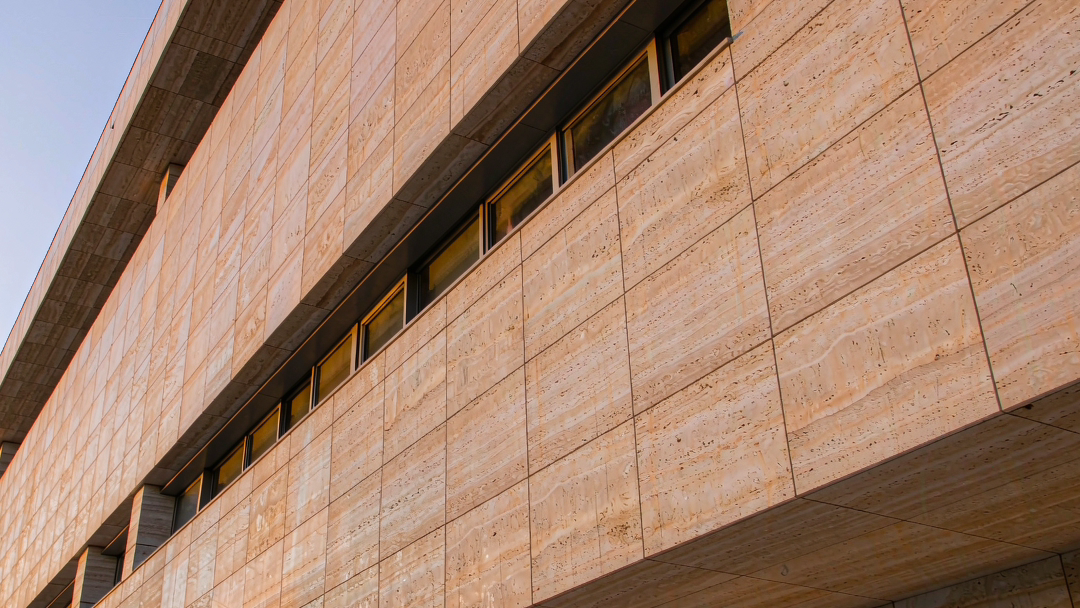
A facade rarely fails because one panel is the wrong colour. It fails because two panels of slightly different tone meet on the same elevation, and nobody agreed in advance which tone was acceptable. Flexible stone (MCM, modified mineral cladding) is a mineral sheet: pigments, aggregate and the forming process all introduce small shifts between production runs. That is normal. Discovering it after the scaffold comes down is not.
Why a mineral sheet shifts between batches
Colour on a 2 to 4 mm flexible stone sheet is carried by a very thin surface layer, so anything that changes that layer shows up quickly. Three inputs move between runs: pigment dispersion in the mix, the mineral aggregate itself, which is a quarried material and never identical twice, and the surface coat, where small differences in thickness change how light is absorbed rather than reflected.
Glazed porcelain can reprint a design panel by panel, and aluminium can be matched to a RAL reference, because both are industrial coatings applied to a consistent substrate. A mineral sheet sits closer to natural stone in behaviour: consistent within a batch, close but not identical across batches. That is also why it does not read as a printed repetition on a large wall, which is the quality architects are usually buying.
Three kinds of variation that get confused
Batch to batch. The whole production run sits slightly warmer, cooler, lighter or darker than a previous run. This is the variation that generates claims, and the only one that can be managed contractually.
Within a batch. Panel to panel differences in veining, mottling and grain are designed. Flexible stone is not a repeated print, and a wall where every panel is identical reads as plastic. Judging single panels side by side under a spotlight produces complaints about a wall that looks correct at three metres.
Condition dependent. The same panel reads differently wet and dry, under cool north light and warm late afternoon sun, and against a dark or light adjacent material. Two people can disagree about one panel simply because they are standing at different angles. Always rule this out before blaming a batch.
Before the order: the approved sample and the retained sample
An approved sample is a contract document, not a courtesy. Three copies should be signed and dated, one held by the designer or owner, one by the contractor, one by the supplier, each marked with the colour reference and the production batch it came from.
The sample must be large enough to judge. A small colour chip tells you almost nothing about how a wall will read: aim for at least 300 by 300 mm, and better still a 600 by 1200 mm board with a joint, so the relationship between two panels is visible. State the viewing condition on the approval sheet, for example daylight from a north-facing window at three metres, and keep the retained sample in a dark drawer rather than on a windowsill, where UV will drift it within a season.
Do not approve colour from a phone photo. White balance, screen calibration and compression will let two parties reach opposite conclusions about the same sheet, and neither will be able to prove the other wrong.
In production: one batch per elevation
Quantities should be split by elevation at order stage, with a spare allowance of roughly 5 to 10 percent taken from the same batch for future damage repair. A spare panel from a later batch is not a spare panel, it is a visible patch.
Ask for same-batch production, same-batch cartons, and the batch number printed on the outside of each carton and on the packing list. Where a project ships in phases, fix the first delivery as the reference and confirm before reordering whether that batch can still be run. Custom colours need a longer approval cycle than stock references, so the confirmation time has to sit outside the quoted lead time rather than be compressed into it.
On site: blend, dry-lay, and keep the record
Open at least three cartons at once and take panels alternately. Blending is the single most effective colour control on site, and it costs nothing but discipline. Keep one batch to one elevation, and allow a deliberate change of batch at a true architectural break, such as a recess, a return or a different plane, where the eye expects a shift.
Dry-lay two rows or more before bedding anything, then step back three metres. Most colour disputes are resolved at this stage, before adhesive is mixed. Record the batch number of each elevation in the handover file, so that a repair two years later can be matched rather than guessed.
Acceptance: light, distance, wet and dry
Judge colour under the light the elevation will actually receive, not under a work light at dusk. Make the overall call at three metres or further, and reserve close inspection for surface defects rather than tone. Compare panels in the same moisture state: a mineral surface with water absorption below 0.1 still darkens visibly after rain, and a wall half wet and half dry will look like two batches when it is one.
Internal and external corners, reveals and soffits read differently because they receive light differently. Treat that as shadow, not as variation, and check before it is written up as a defect.
When the difference is genuine
Gather evidence first: batch numbers, location on the elevation, the proportion of area affected, and photographs taken in one lighting condition with the retained sample in frame. A claim without a batch number is hard to act on for either side.
Where the deviation is real and localised, replacing a small area from the original batch is almost always better than recoating or stripping a whole elevation. Where a batch-to-batch offset appears across a project, the practical answer is often to concentrate the difference on a secondary or rear elevation, which is a decision best taken at design stage while there is still a choice.
If a tolerance was written into the contract, whether as a measured colour difference or as a visual rating under agreed lighting, that document settles the conversation. If it was not, the conversation becomes an opinion, and opinions on a facade are expensive.
What this means for buyers
Colour is the one variable a buyer cannot inspect from a data sheet. Treat the approved sample as a contract document, order by elevation with a same-batch spare, blend on site, and record batch numbers. Those four habits remove most colour arguments before they start, and they cost nothing except a decision made early.
Yangphen Stone produces flexible stone veneer in 2 to 4 mm sheets across slate, cultured stone, marble, brick, wood grain and custom colour references. Retained samples, batch numbers and packing lists are issued with each order, and project quantities can be scheduled by elevation on request. For a colour reference or a sample board for approval, contact our technical team.
See the look board, or request a sample and the current data sheet.
 Specify this look · Mosaic Travertine
 Specify this look · Cement Cast
 Specify this look · Boulder Slab
Specifying a wall? Ask for the current data sheet and a sample of the look.