Industry
How to clean flexible stone cladding without dulling the mineral face
The mineral face does not dull with age; it dulls with chemistry. What is safe to put on a 2-4 mm flexible stone sheet, what is not, and the routine that keeps the texture.
In brief
- Water, a pH-neutral detergent and a soft pad clean the face; acid, solvent and abrasive pads dull it.
- Test any new cleaner on a sample panel or a hidden area before it touches the main wall.
- Clean top down in small panels, squeegee the rinse off, and inspect joints twice a year.
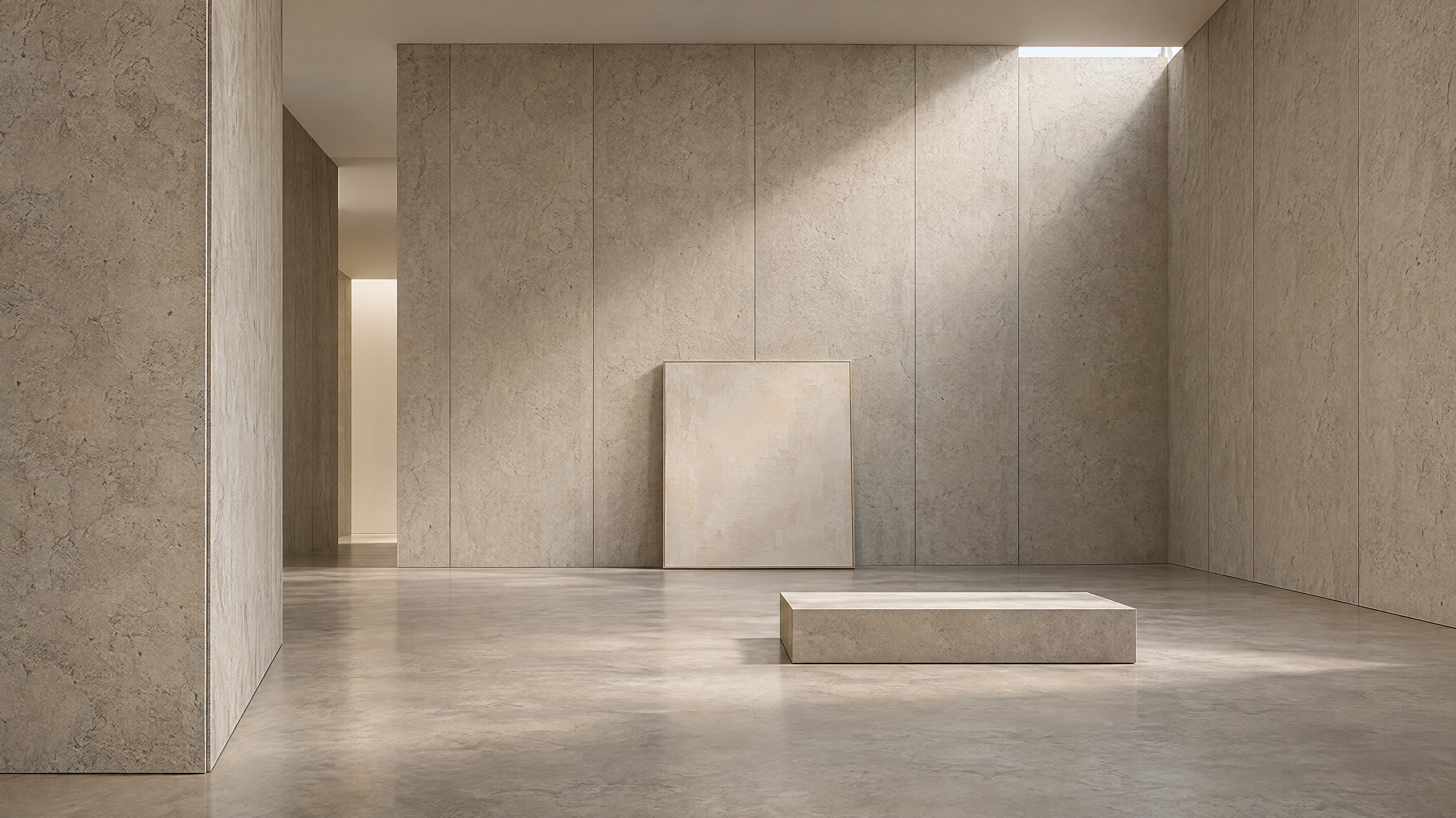
To clean flexible stone cladding without dulling the face, use water, a pH-neutral detergent and a soft pad - and keep acids, solvents and abrasive pads away from the wall entirely. The mineral face does not lose its texture with age; it loses it the first time someone attacks a scuff with the wrong chemistry. This guide explains why the surface reacts that way, which products are safe on a 2-4 mm flexible stone sheet, a six-step routine a facility team can run without training, and how often each type of wall actually needs attention.
Why the mineral face dulls, and what actually causes it
The visible surface of the sheet is a modified mineral layer a fraction of a millimetre deep, and everything the eye reads as texture - the grain of a travertine, the cast of a concrete face - lives in that layer. Stain resistance reaches Grade 4/3 on the series tests, which covers most food, oil and marker marks, but stain resistance and chemical resistance are different properties. A solvent that softens the binder, an acid that etches the minerals, or an abrasive pad that cuts the surface flat will each leave a dull patch that no later cleaning will bring back. That is why flexible stone maintenance is mostly a matter of exclusion: the routine is simple, and the list of things not to do is what protects the face.
The sheet itself is 2-4 mm thick and typically 3-8 kg/m², so there is no thick slab to resurface and no polishing machine to call. A dull patch is a repair, not a refurbishment - which makes the cleaning method the cheapest insurance on the wall.
The chemistry that is safe, and the chemistry that is not
Safe is a short list: water, a pH-neutral detergent at the dilution on its label, and isopropyl alcohol in a low concentration for local marks such as pen or scuff residue. Not safe is a longer one. Avoid acidic cleaners of any strength, including bathroom descalers and brick cleaners; avoid solvent-based products such as thinners, acetone and paint remover; avoid chlorine bleach left to dwell; and avoid abrasive creams, scouring pads and stiff nylon brushes. Pressure washers are a special case: a wide fan at low pressure is acceptable on an open elevation, but a zero-degree jet will cut the face and drive water into the joints, so keep it off the wall near every sealant line.
When a new cleaner has to be introduced - a contract cleaner arrives with its own product list, for example - test it on a sample panel or on a hidden area behind a door first, rinse it off, and let it dry before judging. A cleaner that leaves a dull ring on the test area has answered the question for the whole wall.
The six-step routine
The routine below is the flexible stone maintenance baseline for a flexible stone cladding wall, interior or exterior, run weekly or as needed:
1. Dry-brush the wall from the top down with a soft brush to lift loose dust. Wetting dust first only drives it into the texture.
2. Mix the pH-neutral detergent at label dilution in clean water. Stronger is not better; the dose that cleans a panel is the dose that leaves the binder alone.
3. Wash in small panels with a soft cloth or sponge, working top down, so the wall never dries halfway through a pass and no tide line is left at the bottom edge.
4. Rinse with clean water and pull the rinse off with a squeegee rather than letting it run down and dry on the face. On exterior walls, rinse from the top and let gravity carry the water past the joints, not into them.
5. Lift the marks the wash did not take - trolley scuffs, transfer prints, marker - with a non-abrasive white pad and, if needed, a low-concentration alcohol wipe, then re-rinse the area. Grade 4/3 stain resistance covers most marks; the ones it does not cover yield to patience, not to stronger chemistry.
6. Inspect joints, edges and sealant lines while the wall is wet, reseal anything that has pulled away, and note it in the maintenance log with a photograph.
No step in that routine involves a coating, a wax or a sealer on the face. The sheet ships finished; adding films on top is how walls start to look patchy under raking light.
How often each wall needs it
Frequency follows traffic, not the calendar. On interior feature wall cladding in a hotel corridor or a lift lobby, the band between 600 and 1,000 mm takes the contact - trolleys, luggage, hands - so flexible stone maintenance indoors is a light weekly wipe of that band and a full-wall wash monthly. In a gallery or a private interior, quarterly is usually enough. Retail walls follow the fitting-out cycle: clean after every fixture change, because the marks made during de-rig are the ones that set hardest.
Exterior work is driven by weathering rather than touch. On exterior facade cladding the base course and the splash zone collect the dirt, so wash the lower two metres twice a year and the whole elevation annually, and treat any green film in shaded, damp corners as a signal to improve drainage or trim planting rather than to escalate the chemistry. The series is tested to 100 freeze-thaw cycles and water absorption below 0.1 kg/m²·h⁰·⁵, so the sheet itself does not drink the dirt; what the wash removes is on the surface, which is exactly why gentle works.
What this means for commercial maintenance contracts
The trend in tenders is that the cleaning schedule now travels with the material submission. Buyers in the Middle East and Southeast Asia increasingly ask for the maintenance method, the approved chemical list and the repair procedure in the same document as the fire report, because the cost that overruns a wall is rarely the facing - it is a contractor using the wrong product and a wall that has to be patched. Flexible stone maintenance fits that submission easily: the routine above, the batch record for matching repairs, and a note that tensile strength above 1.0 MPa and ageing tested to 1,200-3,500 hours back the expectation that the face survives the routine.
Yangphen Stone (Zhongshan, China) has run its own plant since 2006, with roughly 10,000 m² of production space, about 150,000 m² of monthly capacity, and more than 30,000 companies served. Production forms the sheet at low temperature rather than firing near 1,000 °C, which keeps the face chemistry consistent from batch to batch - the reason a cleaning method tested on a sample still applies to a top-up order two years later.
What to confirm before specification
Ask the supplier for the approved cleaning method in writing, together with the adhesive schedule, the joint detail and the fire report for the thickness you are buying. Request samples and run the six-step routine on a sample panel, including one deliberate scuff-and-clean cycle, before the order is placed; then confirm the current series data sheet before the wall is locked. A flexible stone manufacturer that puts the cleaning method in the same document as the test data is the one whose walls will still read flat in year ten.
See the look board, or request a sample and the current data sheet.

Specifying a wall? Ask for the current data sheet and a sample of the look.