Industry
Flexible stone vs natural stone cost: what changes per square metre
The sheet price is the smallest part of the comparison. Mass, access, waste and programme decide the cost per square metre, and only one of the two materials changes all four.
In brief
- Stone quotes the slab; the frame, anchors, lifting and structural allowance sit behind it.
- At 3-8 kg/m² against 10-40 kg/m², the facing changes what the structure has to carry.
- Compare five lines, not one: facing, fixity, access, programme and whole-life cost.
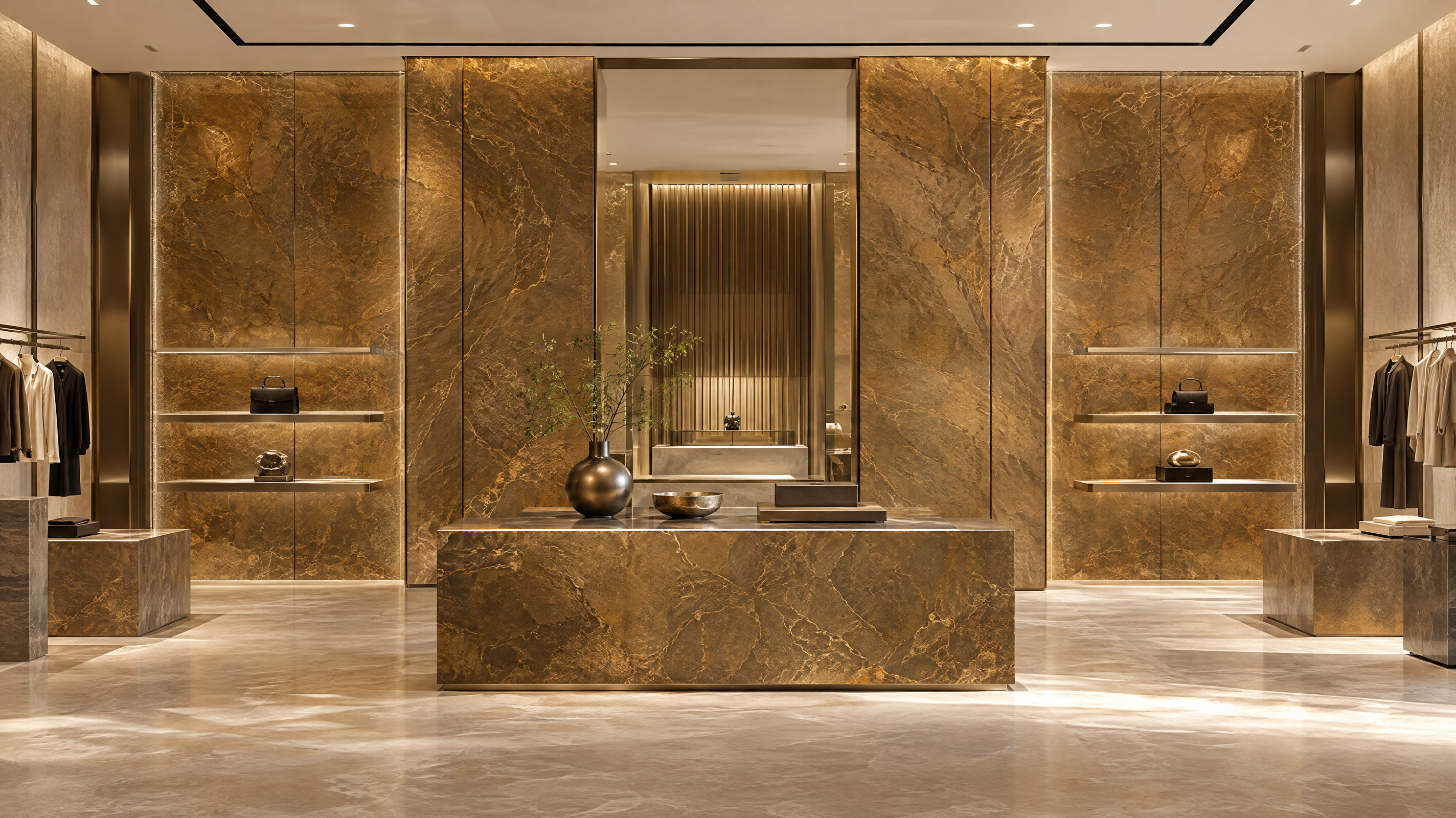
Flexible stone vs natural stone is rarely a fair comparison at the sheet price, because the two materials are priced as different assemblies. A stone elevation is quoted by the slab and then carries the frame, the anchors, the lifting and the structural allowance that 10-40 kg/m² demands; a mineral sheet is quoted with adhesive and a far lighter build-up. What actually changes per square metre is mass, access, waste and programme, and those four usually decide the tender rather than the face price. This comparison sets out which cost lines move, which stay the same, and what to ask a supplier before the numbers are fixed.
Where flexible stone vs natural stone stops being like for like
A natural stone facade is a hung assembly. Every slab arrives at 10-40 kg/m², so the support frame, the anchor pattern, the crane time and the structural allowance all sit behind the slab rate without appearing on the slab quotation. A flexible stone cladding wall is an adhesive assembly: the sheet is 2-4 mm thick and typically 3-8 kg/m², so the same square metre lands on the wall without a frame sized for stone. Comparing the two at the material line is comparing a panel against a wall system.
That is why two quotations for one elevation can differ by a factor that has nothing to do with either material. Ask what each number includes: substrate preparation, adhesive or anchors, access, waste allowance, and the labour hours behind every square metre. Once those lines sit on one sheet, the comparison becomes arithmetic instead of negotiation.
The cost lines that move: mass, substrate and access
Mass is the first line that moves, and it is the reason lightweight stone cladding reads cheaper once the structure is priced. At 3-8 kg/m² the sheet can face an insulated elevation or a lightweight build-up that would need extra framing for stone, and on high-rise work that difference is carried by the structure rather than by the cladding package. When a high rise facade material is chosen at this weight, the build-up needs fewer anchors, smaller profiles and less lifting capacity on site, and each of those is a line a quantity surveyor can price.
Access is the second. A 2-4 mm sheet ships flat, stacks on a pallet and loads a floor without crane time, so a retail unit can be worked from a small platform and a stair core can be finished without a hoist booking. Stone needs lifting gear, and lifting gear needs a schedule, a permit and a day rate that runs whether or not the wall is ready.
Waste is the third. A mineral sheet is cut with a hand tool on site, and an offcut can return on the next pier or the next return; a slab that chips at the edge is scrap, and the replacement may travel alone. Batch records travel with the sheets, so a top-up order - even a container quantity - can be matched to the original run instead of being guessed from a photograph.
Where the difference is specified: retail, hospitality, facade
The comparison lands differently by building type. Retail and hospitality projects usually compare on programme rather than on mass, because a flagship store that must reopen on a fixed date cannot wait for a stone fixity that needs a crane and a permit. On a commercial interior walls scope the sheet goes onto a sound wall with adhesive, and a feature wall can close in a night shift with the shop trading again in the morning.
Exterior work compares on mass and on documentation. The sheets reach Class A fire rating above 3 mm thickness, water absorption stays below 0.1 kg/m²·h⁰·⁵, and the series is tested to 100 cycles of freeze-thaw and 1,200-3,500 hours of ageing - the figures a facade engineer asks for before a thin facing is allowed onto an insulated wall. Certifications include CE, ISO 9001/14001, ASTM fire reports, plus SABER (Saudi), CIDB & COA (Malaysia), and SNI (Indonesia), which is what a tender in those markets checks first.
The trend behind the numbers is that tenders now ask for the assembly rather than the material. Specifiers in the Middle East and Southeast Asia request the adhesive schedule, the fire report and the joint detail in one submission, because the cost that overruns a facade is rarely the facing: it is the access, the rework and the delay. Thin mineral skins moved from a niche specification to a mainstream one once the paperwork caught up with the material, and the paperwork is now the part that decides which supplier stays on the list.
The installation advantage shows up as programme, not as a rate
On flexible stone vs natural stone, the largest single saving is often the phase that is never built. Flexible stone faces insulated elevations and renovation overlays without stripping the existing tile. A refurbishment removes the demolition phase, the skip hire, the weather exposure that follows an open wall, and the new render that would have to dry before anything could be bonded to it. None of those lines appear on a material comparison, and all of them appear on the final account.
Production also forms the sheet at low temperature rather than firing near 1,000 °C, which cuts production energy per square metre and keeps the sheet at 2-4 mm - thin enough to cut on site and to wrap a column without a stone core. A sheet that bends removes the templating and the specials that a rigid panel needs at every corner, and templating is where a stone package quietly loses its programme.
A five-line comparison sheet
1. Facing. The square metre rate at the specified look, with wastage and the minimum order stated, plus the price of a single replacement unit.
2. Fixity. Adhesive system or frame, anchors, and the structural allowance behind the facing - the line most often left out of a stone quotation.
3. Access. Crane, hoist or platform time, permits, and the hours each of them consumes on this particular elevation.
4. Programme. Demolition, drying and cure time, the number of trades on the wall, and the day rate that runs while the wall is open.
5. Whole life. Cleaning routine, the cost of replacing one damaged unit, and the lead time for a matching batch five years from now.
Fill the five lines for both materials and the gap usually appears on the second and third line rather than the first. A comparison that stops at the facing rate measures the smallest part of the wall.
What to confirm before specification
Ask for the batch record, the adhesive schedule and the fire report for the series you are buying, then confirm the current series data sheet before the wall is locked. Yangphen Stone (Zhongshan, China) has run its own plant since 2006, with roughly 10,000 m² of production space and about 150,000 m² of monthly capacity, and more than 30,000 companies served - which is why a custom colour or a private label can be quoted without a second supply chain. The plant also carries forty looks across stone, timber, cast and earth families on one mineral sheet. request samples and price the same five lines against the stone option; the flexible stone manufacturer that answers all five in one document is the one worth shortlisting.
See the look board, or request a sample and the current data sheet.


Specifying a wall? Ask for the current data sheet and a sample of the look.