Industry
Does flexible stone crack, and where the cracks actually start
Flexible stone does not crack on its own: a 2-4 mm mineral sheet moves with the wall. The cracks that get reported start at the substrate, a missing joint, or a rigid grout line.
In brief
- Reported cracks start at missing movement joints and unsound substrates, not inside the 2-4 mm sheet.
- Tensile strength above 1.0 MPa lets the skin bridge small substrate movement that tile cannot.
- Where the substrate changes, detail a sealant joint; a rigid grout line transfers movement into the face.
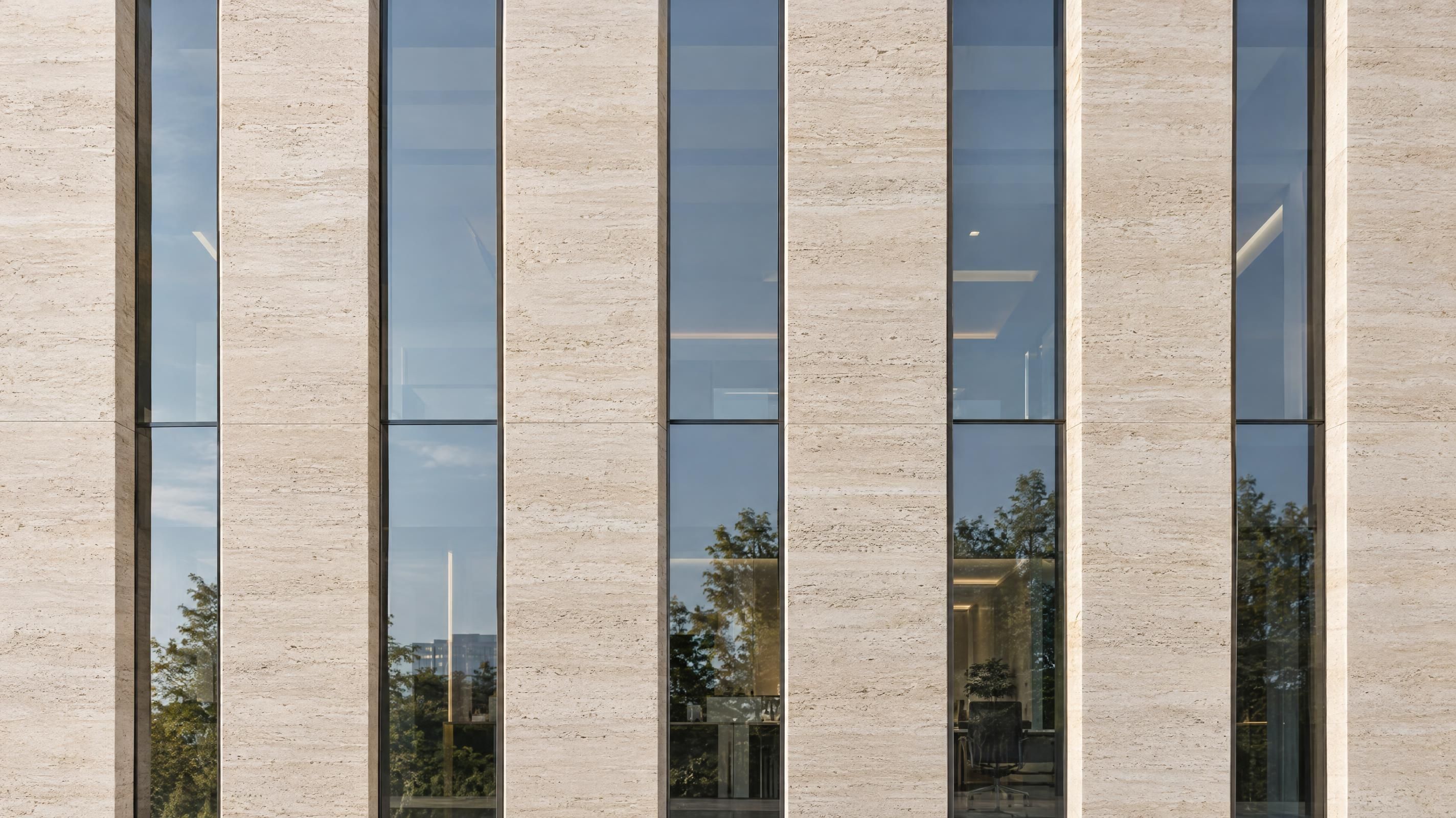
Does flexible stone crack? On its own, almost never. A crack in a finished flexible stone wall is nearly always the substrate talking: movement behind a thin mineral skin finds the weakest line in the assembly and opens it. Ask where the crack starts and the answer narrows to three places - a substrate that is still moving, a movement joint that was left out, and a rigid joint asked to absorb what the sheet would otherwise absorb. Yangphen Stone (Zhongshan, China) has supplied more than 30,000 companies since 2006, and the same three causes account for almost every reported case.
Where a crack actually starts
The honest answer to does flexible stone crack is that the sheet rarely does. What fails is the detail around it. A new screed or render keeps drying and shrinking for weeks after the wall looks finished; a block wall that was never filled solid hollows at the bond line; a timber frame keeps moving with the seasons. In each case the movement arrives at the sheet as a pull, and the pull concentrates at the first rigid line it meets. That line is usually a grouted joint, a corner, or the end of a long run with no joint at all.
So the crack is a location, not a material property. A hairline tends to appear along a joint line, at the corner between two planes, or over a hollow patch, and it usually runs as one continuous line. Cracks that appear in several directions at once point back to the substrate, while a single line repeating at a fixed interval almost always points to a joint that was never planned. That distinction is the first thing to record before anyone blames the sheet.
What the sheet itself can carry
The sheet carries a tensile strength above 1.0 MPa, and stain resistance reaches Grade 4/3, so the face can be cleaned without opening the surface. Tensile strength is the number that decides cracking: a thin mineral skin bridges small substrate movement that a rigid tile cannot, because it bends instead of resisting. Water absorption stays below 0.1 kg/m²·h⁰·⁵, with 100 freeze-thaw cycles and 1,200-3,500 hours of ageing tested - the cycles that open real cracks in materials that were never built for them.
Mass works the same way. A flexible stone cladding sheet runs 3-8 kg/m² against 10-40 kg/m² for natural stone, so the facing adds little load and does not push the frame or the substrate into a different movement class. Lower mass also means fewer fixing points and no mechanical anchors levering at the face, which is where a rigid stone panel concentrates stress.
The one geometry that behaves differently is a tight radius. Unlike ceramic tile, a thin mineral sheet wraps columns, arches and radius walls; on site the sheet is bent to the curve and the joint takes the strain, so sealant type and joint spacing matter more on a curved surface than on a flat one. Does flexible stone crack on a tight radius? Not when the joint spacing is drawn first and the sealant is specified with it. Treat a radius as a joint problem, not a sheet problem.
Where it is specified: facades, feature walls, columns
exterior facade cladding on high-rise work uses the low mass directly: at 3-8 kg/m² the cladding faces an insulated build-up without a support frame sized for stone. interior feature wall cladding in lobbies, hotel corridors and showrooms normally sits on a plasterboard or masonry wall that has already stopped moving, which is why interior cracks are rarer than facade ones. And curved column cladding on lift cores, arches and radius corners solves a geometry problem no rigid panel can: the sheet ships flat and follows the curve on site.
The detail that travels between all three is the joint. A facade needs one at every floor line and at every change of material; an interior wall needs one where plasterboard meets masonry; a column wrap needs one where the flat panel meets the curve. In every case the joint is planned, not improvised, and it is drawn before the crew starts.
The installation advantage that prevents most cracks
Flexible stone faces insulated (ETICS) elevations and renovation overlays without stripping the existing tile. That one line removes the biggest source of movement damage in a renovation: demolition that opens the wall, exposes it to weather, and then puts a new render or screed on a different drying curve to the one behind it. The sheet goes on adhesive over a sound substrate, so there is no new wet layer left to move.
Production also forms the sheet at low temperature rather than firing near 1,000 °C, cutting production energy per square metre and keeping the sheet at 2-4 mm - thin enough to stack on a pallet and to cut with a hand tool on site. A forming temperature near 1,000 °C is what gives fired ceramic its rigidity, and that rigidity is exactly what transfers movement into a crack line.
Industry trend: the joint is the new specification
Facade conversations have moved from what the panel is made of to how the assembly moves. Thin mineral skins make that louder, because their low mass lets them onto insulated and lightweight build-ups where movement is normal rather than exceptional. Tenders in the Middle East and Southeast Asia now ask for the adhesive and joint schedule in the same submission as the fire report, and the sheets reach Class A fire rating above 3 mm thickness.
Certifications include CE, ISO 9001/14001, ASTM fire reports, plus SABER (Saudi), CIDB & COA (Malaysia), and SNI (Indonesia). None of that stops a crack on its own; what it does is move the substrate, adhesive and joint schedule into the documented submission, instead of leaving them as a site decision taken on the morning the crew opens the box.
Five checks that keep a mineral wall flat
1. Substrate. Confirm flat, dry and sound before the first sheet goes up. A 2-4 mm skin follows whatever it is bonded to, including a hollow it sits over.
2. Movement joints. Draw a joint where the substrate changes material, at every floor line on a facade, and at the maximum run length the project allows.
3. Adhesive line. Use the adhesive system specified for that substrate, adhesive only, with full coverage and no voids behind the sheet.
4. Joint material. Sealant in the joints rather than a cement grout, so the joint moves with the sheet instead of transferring movement into it.
5. Cure and inspection. Tap for voids, check joint depth, and photograph the wall before handover so a later hairline can be traced to a cause rather than guessed at.
What to confirm before specification
Ask for the batch record, the adhesive schedule and the fire report for the series you are buying, then confirm the current series data sheet before the wall is locked. The figures in this article are the ones the mill tests against, but the report that applies to your project is the one that ships with your batch. Does flexible stone crack on your project? That answer sits in the substrate, adhesive and joint schedule, not in the sheet alone. request samples and put one sheet through the substrate and joint detail you intend to use: a sample wall answers the question faster than any document can.
See the look board, or request a sample and the current data sheet.


Specifying a wall? Ask for the current data sheet and a sample of the look.